EN


Why Wedge Anchors Fail in Overhead Mounting Applications and Fixes
An Anchor in an overhead installation does more than hold a fixture in place. It carries a sustained tension demand while gravity works in the same direction as any installation or selection error. That is why a wedge anchor can appear acceptable during a quick visual check yet still be an unsuitable choice for the actual concrete, load path, approval scope, or installation condition.
For construction and steel-structure contractors, the useful question is not “Will this anchor tighten?” It is “Is this complete anchor system specifically suitable for this overhead duty?” A positive answer requires the right product documentation, a project-specific design, controlled installation, and a record that allows the work to be checked later.
Why overhead mounting changes the decision
A mechanical Anchor develops resistance through interaction with the base material. With a wedge anchor, tightening expands the clip against the hole wall. In overhead service, the applied load is commonly tension-dominant, may be sustained for long periods, and can be sensitive to concrete cracking, edge distance, spacing, embedment, and vibration from attached equipment. The load path also includes the fixture, rod, nut, washer, and connection—not just the anchor body.
Many crews reasonably begin with a familiar fastener, especially when the concrete looks solid and the load seems modest. But a familiar product type is not an approval. A concrete anchor must be evaluated for the actual base material and loading direction under the governing project requirements. Ratings from a catalog cannot simply be transferred between diameters, embedments, concrete conditions, or overhead configurations.
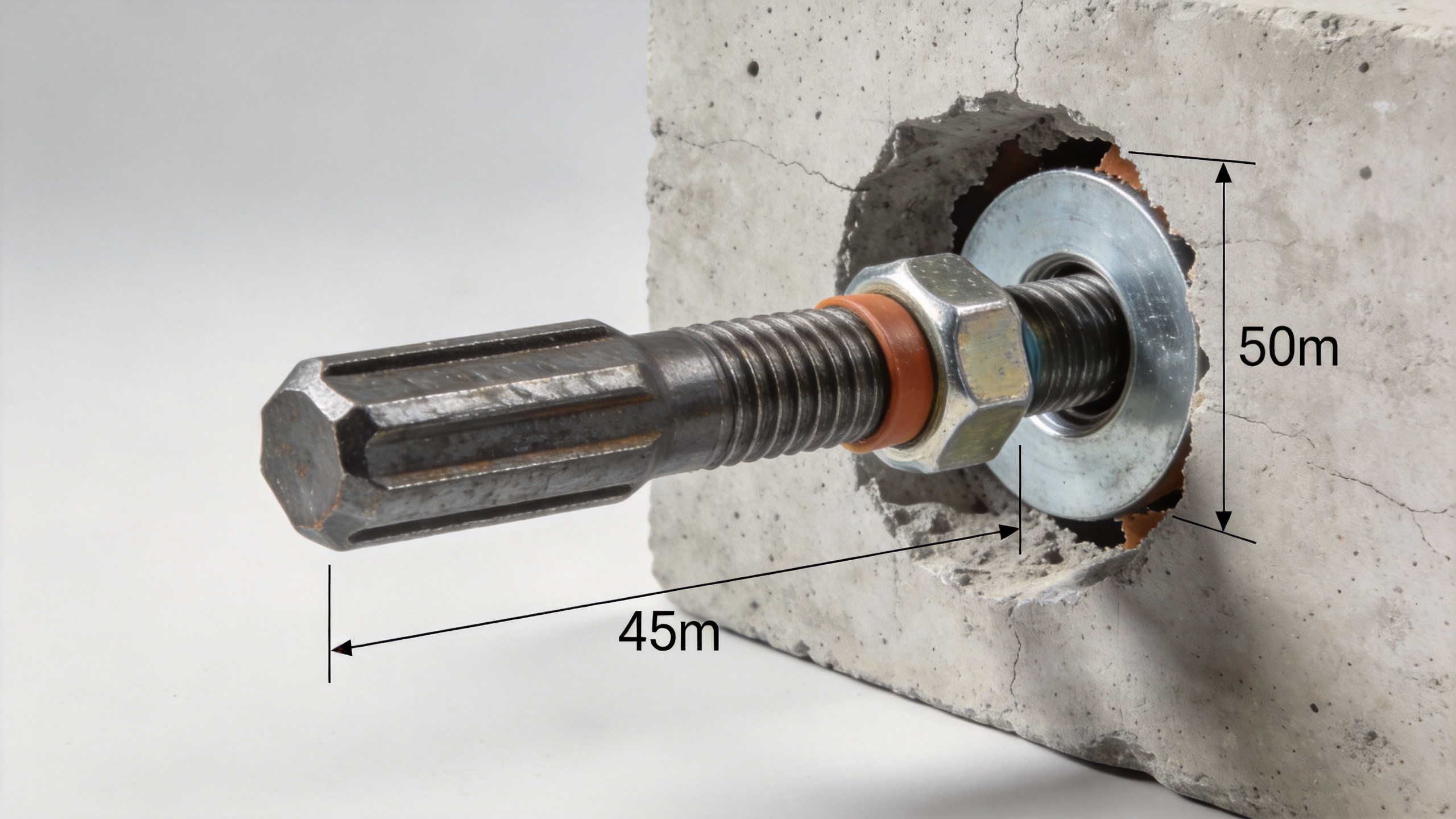
Five reasons wedge anchors can fail or become unsuitable overhead
1. The selected wedge anchor is outside its evaluated use
Not every wedge anchor is evaluated for every overhead application. The manufacturer’s current instructions and evaluation documentation define the permissible base materials, concrete condition, installation direction, load type, and design method. Using a general-purpose wedge anchor where the documentation does not cover overhead tension, cracked concrete, or the required service condition turns an engineered decision into an assumption.
Fix: Before drilling, compare the project specification and engineer’s design with the exact anchor model, diameter, material, and approval documentation. If the published scope does not clearly address the application, pause and obtain a qualified design decision rather than substituting by appearance.
2. Concrete condition and geometry are treated as minor details
A wedge anchor transfers force into concrete near the hole. Cracks, low-strength material, thin slabs, close edges, nearby reinforcement, short spacing, or an unverified existing slab can change the governing failure mode. The issue is not that every crack causes a failure; it is that the product’s allowable design value and installation limitations must match the condition that actually exists.
Fix: Confirm the base-material type, thickness, concrete condition assumed by the design, edge distances, spacing, and embedment before work begins. Do not use field convenience—such as moving a hanger closer to an edge—as a substitute for a revised layout review.
3. Hole preparation or embedment is inconsistent
Mechanical anchoring is sensitive to the drilled hole. An oversized hole, shallow drilling, damaged hole wall, inadequate embedment, or drilling through a thin section can reduce the intended interaction between the anchor and concrete. A wedge anchor may still feel tight because the nut turns, while its installed geometry no longer matches the published system.
Fix: Use the specified bit diameter and depth control, check embedment against the product instructions, and protect the hole from damage before setting the anchor. Record any conflict with reinforcement or an unexpected void; moving or reworking an anchor location needs the same level of review as the original layout.
4. Torque is guessed instead of controlled
Torque activates the expansion mechanism, but “tighter” is not a universal improvement. Under-torque can leave the expansion clip insufficiently set; excessive torque can damage threads, distort the connection, or overstress the concrete around the hole. Field feel is not a reliable verification method for a critical overhead anchor.
Fix: Use the manufacturer’s specified installation torque and a calibrated torque tool where the installation instructions require it. Train installers to distinguish the installation torque from a structural design calculation, and document the inspection process for the project record.
5. The assembly is checked only at the anchor head
Overhead failures can originate above the concrete. A threaded rod may be misaligned, a nut may not have full engagement, a hanger may introduce eccentricity, or a fixture may apply vibration or prying that was not included in the original design. A sound wedge anchor does not correct a weak connection assembly.
Fix: Review the full load path: fixture, attachment point, rod or bolt, washer, nut engagement, clearances, and anticipated movement. Where a load is dynamic, eccentric, or safety-critical, route the final selection through the responsible design professional.
Do not treat anchor types as automatic substitutes
A sleeve anchor, a concrete anchor, and a drop in anchor are names for different fastening approaches, not interchangeable answers. A sleeve anchor may suit some base materials and light-to-medium fastening work; a drop in anchor can support threaded-rod arrangements when its specific product documentation and installation method fit the application. Neither label confirms overhead suitability. The selected Anchor must be evaluated as a complete, named system.
| Question to ask | Why it matters overhead |
|---|---|
| Is the exact product evaluated for this base material and load direction? | Product scope, concrete condition, and design method can limit use. |
| What load reaches each anchor after connection geometry is considered? | Uneven loading, eccentricity, and vibration can change the demand. |
| Are hole diameter, depth, embedment, and torque controlled? | Mechanical anchor performance depends on installation matching the instructions. |
| Who verifies the installed work? | A clear inspection record makes later review and corrective work possible. |
A practical corrective plan for existing overhead anchors
- Secure the area first. If a fixture shows movement, cracking, deformation, loose hardware, or an unknown load path, restrict access and follow the site’s safety procedure.
- Collect facts before selecting a repair. Identify the anchor model if possible, diameter, embedment, fixture load, concrete condition, hole layout, and any installation records.
- Obtain a qualified evaluation. The responsible engineer or qualified anchor-design professional should determine whether the existing system can remain, requires supplemental anchorage, or should be replaced.
- Use a documented repair detail. The repair must state the exact anchor system, drilling and installation controls, inspection requirements, and load-path details.
- Verify and retain records. Keep product documentation, installation logs, torque or inspection records where applicable, and any approved design revision.
Build procurement controls into the Anchor specification
For project purchasing, the lowest quoted item is rarely the complete comparison. Ask suppliers for traceable product identification, applicable standards documentation, installation instructions, material information when required, and support for confirming the specified configuration. Qingdao Jeekuu Hardware Products Co., Ltd. can support technical communication, inspection-process discussion, standards documentation requests, and mill-certificate coordination for suitable fastener orders; final overhead anchor design and application approval remain the responsibility of the project’s qualified professionals.
In practice, reliable overhead fastening comes from aligning the product, base material, design, installation, and inspection. Treat the Anchor as a system rather than a commodity, and a wedge anchor can be evaluated on evidence instead of habit.