EN

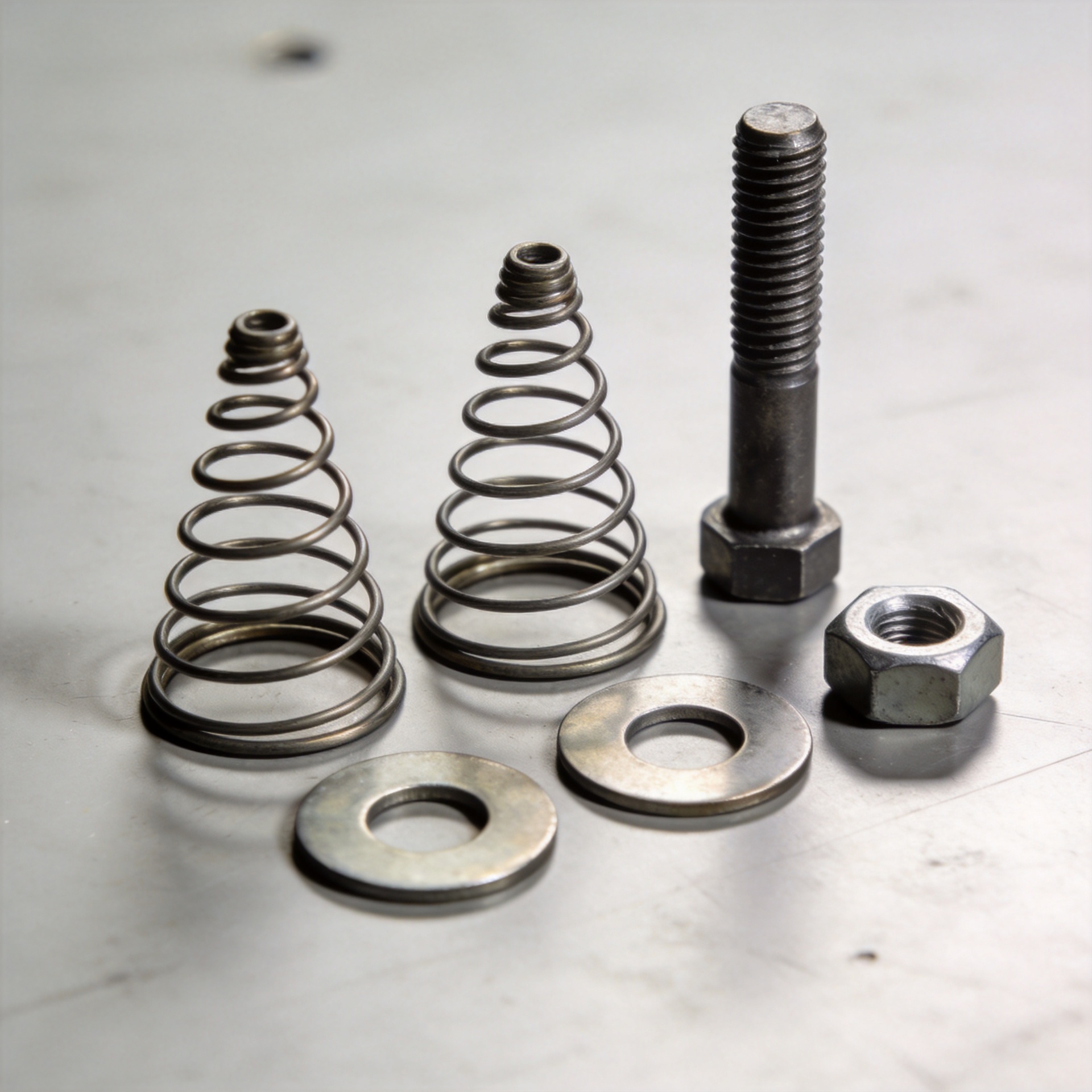
Understanding Spring Washer Mechanics and Why They Self Lock
In fastener work, a washer is not automatically a locking device. It can spread bearing load, protect a surface, maintain contact pressure, or seal a joint. A spring washer adds elastic deflection to that list. Understanding what that deflection can—and cannot—do is the starting point for selecting a component that fits the joint rather than relying on a familiar shape.
From a fastener-selection perspective, the first questions are the clamped-material stack, preload, vibration direction, corrosion exposure, and installation method. A spring washer can help a bolted joint accommodate limited settlement or thermal movement in the right arrangement. It does not, by itself, make every screw connection immune to rotation under vibration.
What happens when a bolted joint is tightened?
Tightening a screw or nut stretches the fastener and compresses the parts being clamped. The resulting clamp force creates friction at the joint faces and under the bearing surface. That preload is the main reason the assembly stays together. The disc beneath the nut or bolt head changes how load reaches the surface below.
When service vibration causes the clamped parts to move sideways relative to each other, friction can be overcome. Once there is repeated transverse slip, the threads and bearing surfaces can move in a way that permits rotation and a loss of preload. This is the mechanism behind many cases of rotational self-loosening. It is why the phrase “self lock” needs a qualification: a part may contribute to preload retention or resistance at a contact surface, but its geometry and the real joint motion determine whether it resists loosening.
How a spring washer works
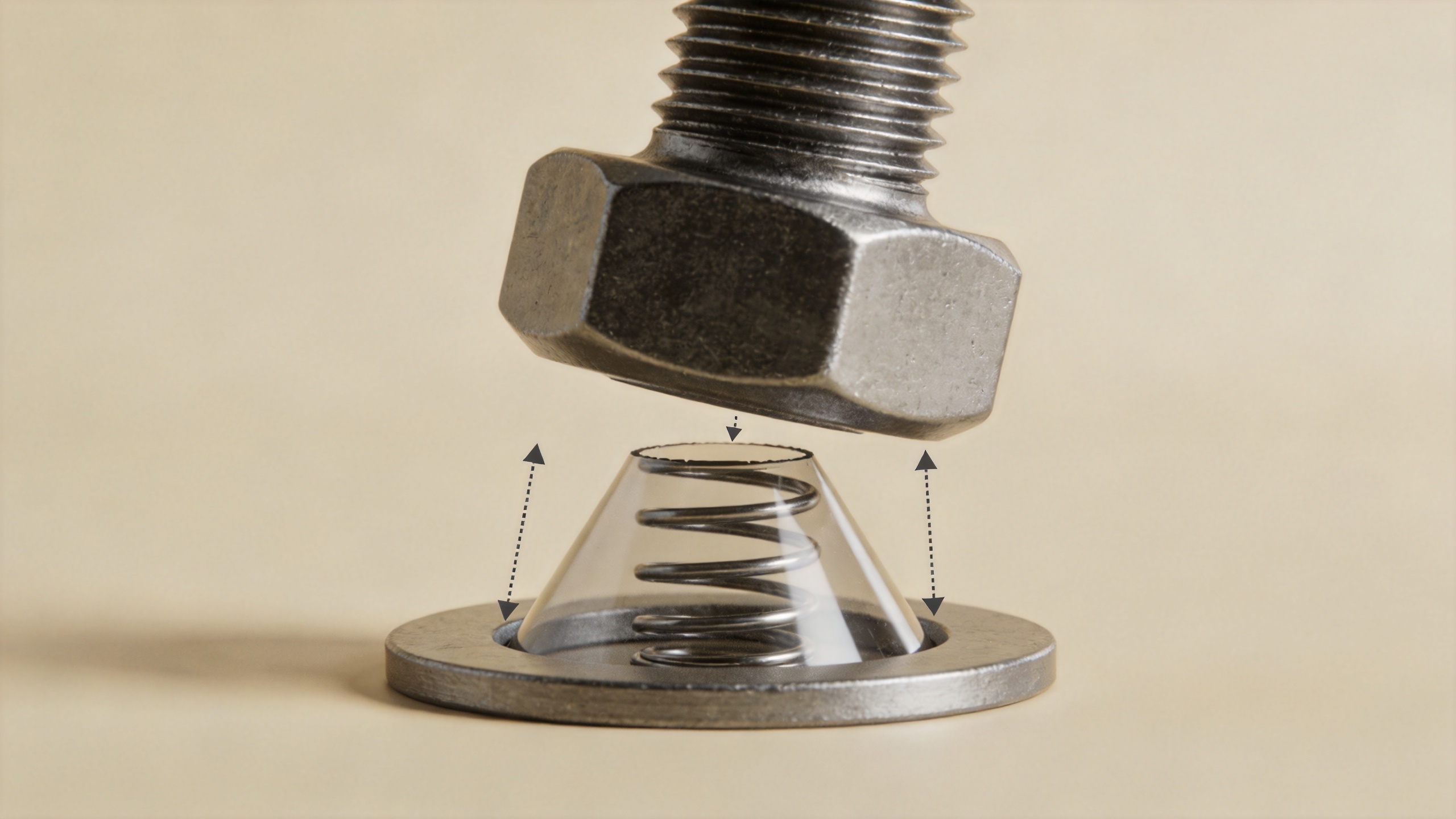
A spring washer is made with a shape that deflects under tightening. Its elastic travel stores a modest amount of energy. If small amounts of embedment occur—such as local flattening of surface roughness, coating compression, or minor settlement—the stored spring force can help the assembly retain contact pressure. The practical benefit depends on the load-deflection curve, the target preload, the stiffness of the bolt and clamped parts, and whether the component remains within its intended operating range.
For this reason, this term is a broad functional label, not a single performance class. A thin split or helical form, a toothed locking type, and a heavy conical disc behave differently. Treating them as interchangeable is a common source of poor fastener decisions.
Why a split spring washer is not a universal lock washer
The familiar split lock washer has a helical cut and raised ends. Before tightening, its form suggests that it will act like a spring and bite into the mating faces. During tightening, however, it often flattens. Under meaningful preload, its remaining deflection may be small compared with the stiffness of the complete joint. The raised ends can also mark the bearing surface, which may be unacceptable on coated, painted, soft, or finished parts.
More importantly, a split type should not be assumed to stop rotation during severe transverse vibration. Where dynamic lateral movement is expected, validate the complete fastener system with the required joint geometry, torque procedure, and test method. A conventional lock washer may be reasonable for a specified legacy assembly or low-demand application, but it is not a substitute for engineering a vibration-resistant joint.
Conical spring designs: a different use case
A conical spring washer, sometimes called a disc-spring component, is thicker and has a controlled conical profile. Certain heavy-duty versions are designed to support preload compensation when a joint settles or experiences limited relaxation. Their value is in the designed spring characteristic near the intended working load, rather than in the assumption that a cut end will lock a fastener.
Specifications may refer to families such as DIN 6796 for heavy-duty conical spring parts and DIN 2093 for broader disc-spring applications. Those references are starting points, not a selection shortcut. Confirm the applicable drawing, material, finish, allowable load, deflection, and mating fastener class for the project. A part that is too soft, too small, or flattened during assembly cannot provide the intended spring behavior.
Flat washer, spring washer, lock washer, or sealing washer?
| Type | Primary job | Where it fits | Key caution |
|---|---|---|---|
| Flat washer | Spreads bearing load and protects the surface | Slots, softer materials, painted faces, or general bearing support | A plain disc does not add meaningful locking action on its own. |
| Spring washer | Adds elastic deflection or helps compensate for limited settlement | Joints designed around preload retention and suitable load-deflection behavior | Verify that it is not fully flattened at the target tightening condition. |
| Lock washer | Provides a stated anti-rotation or contact-resistance function | Only where the design and validation support the specific type | “Lock washer” is a category, not proof of vibration performance. |
| Sealing washer | Forms a barrier against fluid, dust, or moisture | Enclosures, covers, roofing, plumbing, and outdoor joints | Do not use sealing performance as evidence of mechanical locking capacity. |
A useful rule is to choose the component by the failure mode. If the concern is bearing pressure, start with a flat washer. If settlement is the concern, evaluate an appropriately designed spring washer. If ingress protection is the concern, specify a sealing washer with compatible material and compression. If vibration-driven rotation is the concern, assess a complete locking strategy rather than selecting a part solely because its name includes “lock.”
A practical selection sequence
- Define the joint. Record fastener size, material stack, grip length, hole type, coating, access, and expected service loads.
- Identify the movement. Distinguish axial relaxation from transverse vibration. They call for different responses.
- Set the tightening method. A disc beneath the head cannot correct inconsistent torque, damaged threads, poor seating, or an unsuitable lubrication condition.
- Match the material and finish. Consider corrosion, galvanic compatibility, temperature, and surface damage. A sealing washer also needs elastomer compatibility with the environment.
- Validate the assembled system. For critical or highly dynamic equipment, use the project’s applicable joint test and acceptance criteria rather than extrapolating from a catalog description.
Installation details that change performance
Many apparent failures begin at installation. Burrs, paint buildup, oversized holes, reused distorted parts, incorrect orientation, and over-tightening can alter the load path. For a conical disc, orientation and specified deflection matter. For a seal, uneven compression can create a leak path. For a flat bearing disc, diameter and hardness affect how load is distributed.
In production, batch consistency matters as much as selecting the right nominal part. Incoming inspection can check dimensions, hardness or material documentation where required, surface condition, and coating condition against the purchase specification. This makes the selection logic repeatable when the same assembly is built across many units.
The bottom line
A washer supports a bolted joint by performing a defined mechanical or sealing function. A spring washer can help retain contact pressure when its spring characteristic matches the joint. It does not automatically self lock a connection exposed to transverse slip. Use a flat washer for bearing support, a sealing washer for environmental sealing, and a spring or lock type only after defining the actual relaxation and vibration problem. That disciplined approach produces a more reliable joint than relying on a part name alone.