EN

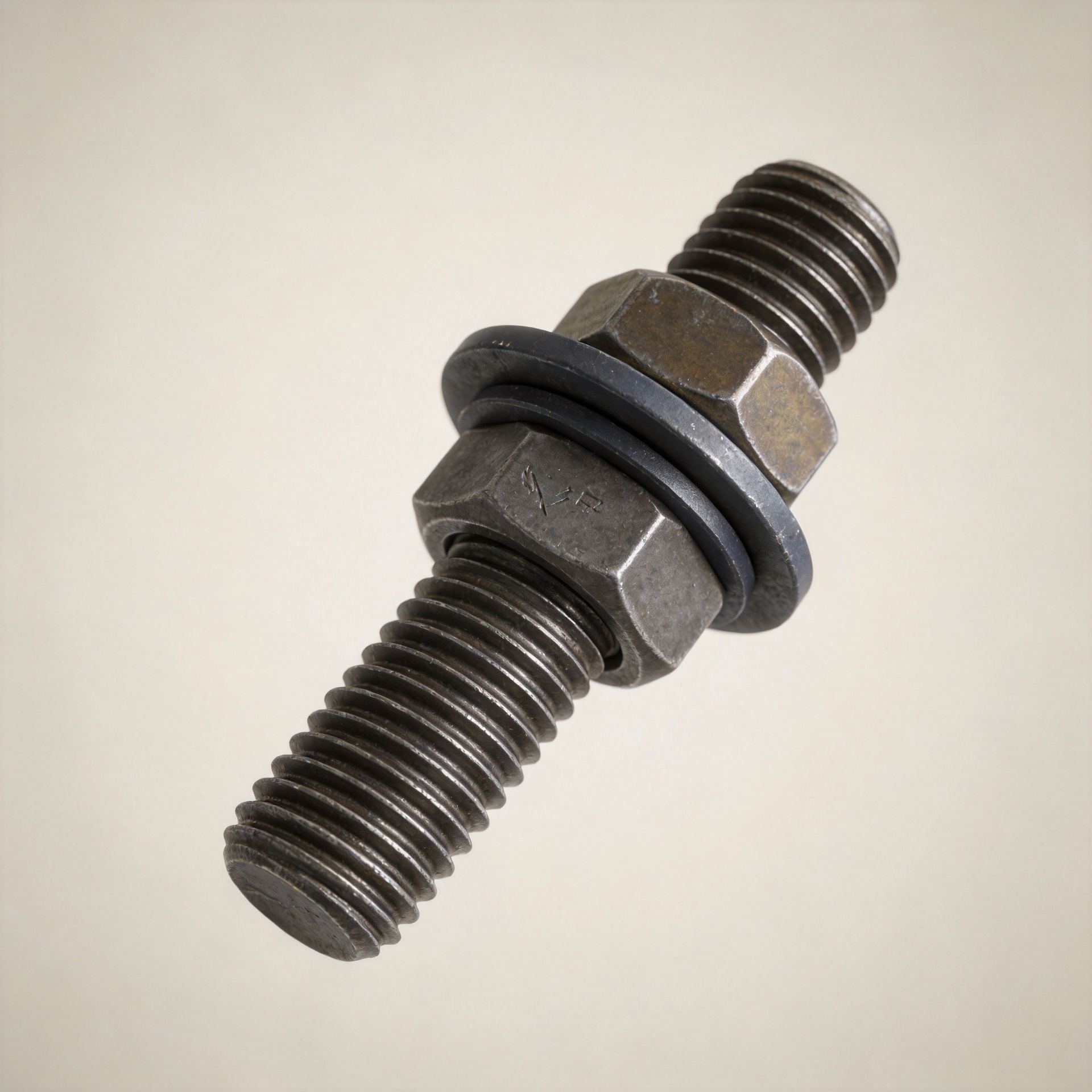
How to Address Washer Flattening in Clamped Heavy Load Joints
A deformed washer in a heavy-load joint is not a cosmetic nuisance. It is evidence that one part of the clamped stack has yielded, and it can change the preload that keeps the connection stable. In a fastener selection review, the useful first question is not “Which washer should replace it?” It is: “What load path drove the bearing stress beyond what this washer-and-joint stack can sustain?” That distinction matters because a new washer with the same geometry and material often repeats the failure.
This guide gives a practical way to diagnose flattening, contain the immediate risk, and specify a more suitable stack. It applies to bolted machine frames, steelwork, brackets, pipe supports, and other joints that carry substantial clamp load, vibration, or thermal cycling. The terms flat washer, lock washer, spring washer, and sealing washer appear here because they serve different jobs; they should not be treated as interchangeable.
Start with the failure mode, not the washer name
Flattening may mean several different things. A plain washer can dish under the nut or bolt head, its bore can flare, its outer edge can imprint into a soft clamped part, or a spring form can lose most of its free height. Each pattern points to a different mechanism. A washer that has yielded cannot be assumed to retain the intended clamp force, so a critical joint should be evaluated before simply being retightened.
| Observed condition | Likely mechanism | First check |
|---|---|---|
| Dished plain washer | Bearing stress or washer hardness is too low for the installed preload | Washer hardness, thickness, outside diameter, and tightening method |
| Hole pulled outward or locally thinned | Undersized bearing area, oversized clearance hole, or edge loading | Hole geometry, alignment, and contact pattern under the head or nut |
| Washer imprinted into a plate | Clamped material has yielded before the washer distributes load effectively | Plate material, thickness, support beneath the surface, and load direction |
| Spring form nearly flat | It was compressed past its useful working range or relied on as a structural bearing washer | Installed height, joint settlement, and the actual locking requirement |
Document the joint before disassembly: bolt size and grade, nut grade, washer dimensions and markings, installed torque or tension method, plate thickness, hole size, surface condition, and any evidence of joint slip. A witness mark across the nut and member helps separate preload loss from a one-time installation issue. If a joint carries a safety-critical or fatigue-sensitive load, have the responsible engineer define the inspection and replacement action.
Why flattening changes clamp-load behavior
A bolted joint works because bolt stretch creates clamp force. The washer sits in the compressive part of that system. When its contact face plastically deforms, some of the installed displacement is consumed in permanent set rather than retained as elastic clamp load. That is why a connection can look tight after an installation check yet relax after service, especially when vibration, embedment, or repeated loading adds further settlement.
It is tempting to respond by applying more torque. That can worsen the damage. Torque is only an indirect way to develop preload, and friction variation can move a large share of input torque into bearing and thread friction rather than bolt tension. First confirm the specified assembly method and whether the target preload is appropriate for the bolt, washer, and clamped materials as a system.
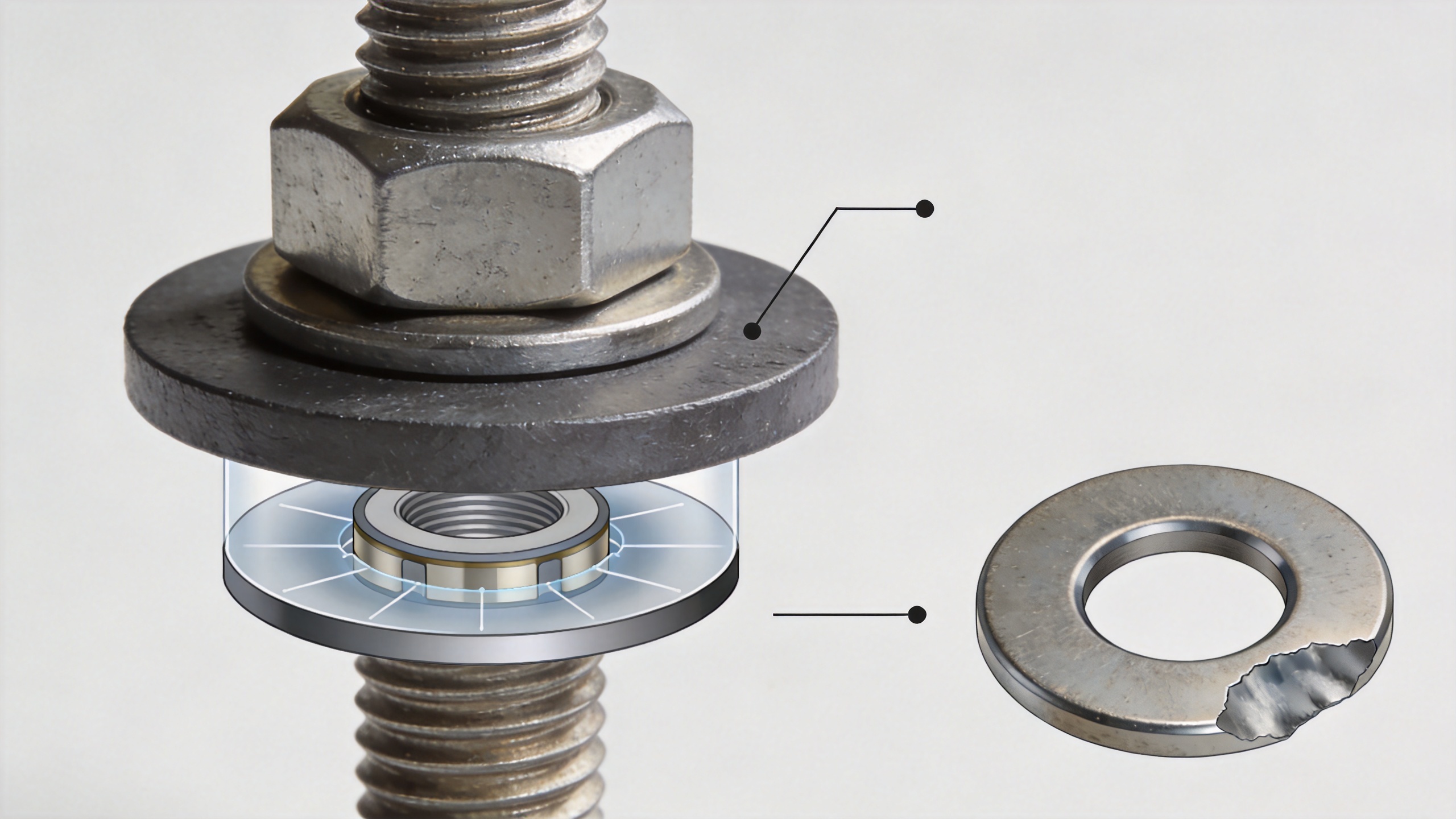
Choose the washer by function
Flat washer: the baseline bearing surface
A flat washer spreads head or nut load over a larger area and protects the mating surface. For a heavy joint, compare the available bearing area with the stiffness and yield resistance of both the washer and the clamped member. Increasing outside diameter can reduce local bearing stress, but only if the support beneath that larger footprint is sound. A thin wide washer placed over a weak slot or unsupported sheet can still bend.
When high-strength hardware is involved, use a washer class and geometry that are compatible with the specified assembly. ISO 898-3 covers mechanical and physical properties for steel flat washers used in bolted joints; the retrieved reference identifies 200HV and 300HV property classes. The same reference notes 300HV as an example intended to mate with property-class 10.9 bolts and property-class 10 nuts. Treat this as a starting point for verification against the current project drawing and applicable standard, not as a universal substitution rule.
Lock washer: address rotation only after the bearing stack is sound
A lock washer may be selected where the joint design calls for resistance to relative rotation, but it does not correct inadequate bearing capacity. If the washer under the head is yielding, adding a locking feature without correcting preload, washer hardness, or contact area leaves the original problem in place. Consider the locking method in the context of vibration level, surface finish, reuse policy, and the joint’s specified standard.
Spring washer: do not use spring action as a substitute for structural support
A spring washer stores a limited amount of elastic deflection. In a heavy clamped joint, its geometry and working range must be checked rather than assumed. If it is driven flat during assembly, it has little remaining travel to accommodate settlement. It also cannot compensate for a soft plate, a thin plain washer, or an overload condition. Use a defined locking or preload-retention approach and validate it in the actual stack.
Sealing washer: preserve sealing without obscuring the structural load path
A sealing washer is selected primarily to control fluid or environmental ingress. Its elastomeric or bonded section can compress substantially, so it needs a defined compression range and compatible mating surfaces. In a high-load structural location, do not let the seal become the only element carrying the bearing load. Often the solution is a dedicated structural bearing arrangement plus a seal designed for the required compression, but the stack must be designed for the specific enclosure or flange.
A corrective sequence for heavy-load joints
- Make the joint safe. Isolate equipment or unload the connection where required. Replace visibly yielded, cracked, corroded, or damaged components; do not reuse a washer whose shape has changed.
- Verify the load case. Review static load, cyclic load, vibration, thermal movement, eccentricity, and any prying action. A joint that sees bending can concentrate load on one side of a washer even when the nominal clamp force looks acceptable.
- Check the mating materials. Confirm the compressive strength, thickness, and flatness of the clamped parts. Add a backing plate, sleeve, spacer, or redesigned contact arrangement if a soft or thin member is being crushed.
- Specify a compatible bearing stack. Select washer hardness, thickness, and outside diameter with the bolt and nut grades in mind. For preloaded structural assemblies, EN 14399-6 is a relevant example: it covers plain chamfered washers for high-strength structural bolting assemblies. Use the exact project standard rather than mixing components from unrelated systems.
- Control installation. Use the approved torque, torque-angle, tensioning, or direct-tension procedure. Clean contact faces as required, avoid unintended lubrication changes, and calibrate tools. Record the method and the lot traceability for critical work.
- Validate after assembly. Inspect seating, alignment, and witness marks. When the application warrants it, use a proof-load, tension-verification, or service-monitoring plan defined by the responsible engineer.
Common fixes that miss the root cause
- Replacing only the washer: This misses a soft plate, oversized hole, misalignment, or excessive preload.
- Using a thicker washer without checking hardness: Thickness may help stiffness, but material strength and compatibility still govern permanent deformation.
- Adding a spring washer to a joint that is already yielding: It does not restore lost bearing capacity and may be flattened during installation.
- Retorquing a settled stack to the old torque value: The resulting bolt tension can differ materially when friction, geometry, or component condition has changed.
- Mixing structural parts by appearance: A coordinated bolt, nut, and washer assembly is not established by matching nominal size alone.
A drawing and purchasing checklist
Before releasing replacement hardware, place the following information on the drawing, purchase specification, or inspection plan: bolt and nut class; washer standard and property class; inside and outside diameter; thickness; coating and corrosion environment; clamped-material grade and thickness; hole type; target preload or approved tightening method; lubrication condition; reuse policy; and acceptance checks. This is usually more valuable than asking a supplier for a generic heavy-duty washer.
Conclusion
Washer flattening is a signal to review the whole clamped joint: preload, bearing area, washer hardness and geometry, mating-material strength, alignment, and installation control. A suitable washer distributes load while staying within its elastic and strength limits; it does not compensate for an overloaded or poorly supported joint. Start with the observed deformation pattern, correct the structural cause, then select the flat, locking, spring, or sealing function that the application actually requires.