EN

Why Flat Washer Material Choices Change Over Time Performance
A washer is often treated as a low-cost line on a bill of materials, yet its material can influence clamp-load retention, surface condition, and maintenance exposure over the life of an assembly. A flat washer does not create locking force by itself. Its usual job is to spread bearing load, protect the joint surface, and provide a consistent contact surface beneath a fastener head or nut. Whether it continues to do that job depends on the material, finish, hardness, environment, and installation practice working together.
From a fastener-selection engineer’s perspective, the useful question is not “Which washer is strongest?” It is: what will happen to this washer after repeated tightening, vibration, moisture, temperature changes, or contact with a different metal? The answer can change a routine joint into a recurring inspection item.
Start with the function of the washer in the joint
Before choosing material, separate the functions that are often grouped under the word washer. A flat washer distributes compressive load over a larger area and can reduce local marking or embedding on the clamped part. A lock washer is intended to contribute to resistance against loosening in a specified joint design. A spring washer adds elastic behavior, but that does not automatically make it the right answer for every vibration problem. A sealing washer combines a rigid support with an elastomeric or soft sealing element to control leakage around a fastener.
These functions should not be substituted casually. A corrosion-resistant flat washer may protect a painted enclosure, but it is not automatically a replacement for a sealing washer in a fluid boundary. Likewise, adding a spring washer does not correct a flat washer that is too soft for the bearing load or too vulnerable to the service environment.
How material affects performance over time
Carbon steel: economical, but dependent on finish and environment
Carbon-steel flat washers are widely used where strength, availability, and cost control matter. In dry indoor service, a suitable steel washer can be practical when its hardness and dimensions match the joint. The long-term limitation is exposure: unprotected steel can corrode, and a coating can be damaged during handling, tightening, or service. Zinc plating is commonly used to add corrosion protection, but its suitability depends on the atmosphere, drainage, chemical contact, and expected maintenance interval.
As corrosion develops, the bearing surface can become uneven. That may affect torque-to-tension consistency at reassembly and can leave rust products between the washer and the clamped part. For outdoor equipment, coastal exposure, washdown areas, or locations where water remains around the joint, specify the finish as a performance requirement rather than treating it as a cosmetic detail.
Stainless steel: corrosion resistance with compatibility checks
Stainless steel is often selected when atmospheric corrosion is a material risk. Common grades have different resistance profiles, so “stainless” alone is not a complete specification. For example, a grade that is adequate in many indoor, outdoor, or freshwater settings may need reassessment in chloride-bearing environments or where deposits remain wet. The mating fastener, clamped materials, and access for cleaning all matter.
There is also a mechanical side to the decision. Stainless washer hardness, thickness, and bearing area should suit the bolt preload and the substrate. In a soft aluminum, coated panel, or polymeric component, even a corrosion-resistant washer can allow indentation if the contact pressure is not controlled. Mixed-metal joints deserve particular attention because moisture can turn material pairing into a galvanic-corrosion concern.
Brass, aluminum, and nonmetallic materials: select for the contact surface
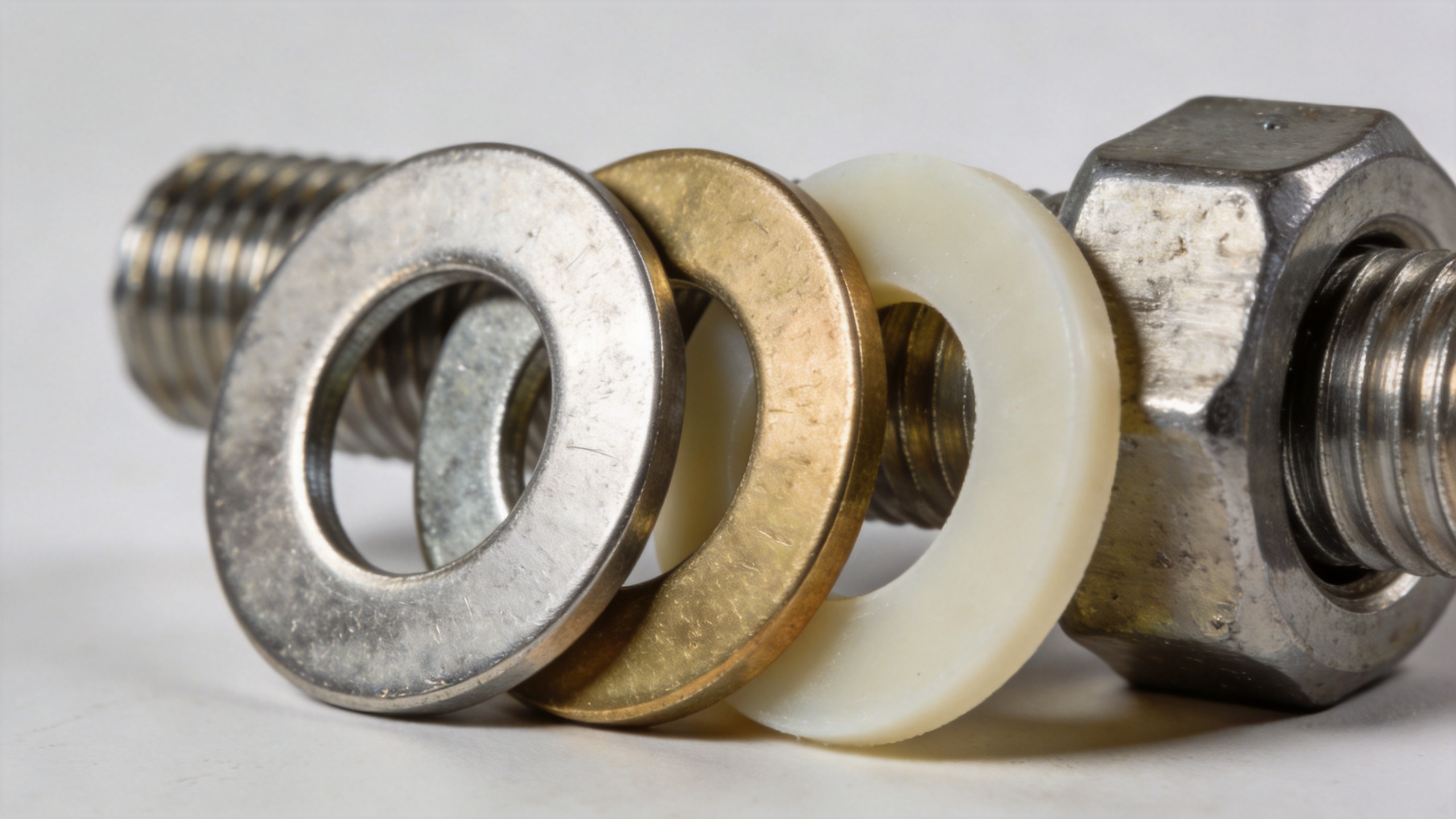
Brass washers can be useful where conductivity, appearance, or reduced risk of sparking is relevant, but their load capacity and corrosion behavior should be checked against the assembly conditions. Aluminum washers may suit compatible lightweight assemblies, yet they can deform under high bearing stress. Nylon, fiber, and other nonmetallic washer materials can provide electrical isolation, cushioning, or chemical compatibility; they should be evaluated for creep, temperature, and compression-set behavior before they are used in a preload-critical joint.
The common mistake is to choose the washer material solely by what the bolt is made from. The joint surface, load path, environment, and service plan are equally important.
Hardness, thickness, and geometry are material decisions too
Material selection is not finished when a metal grade is named. A washer that is too soft may embed into the joint surface under preload, reducing effective clamp load after the initial installation. A washer that is too thin may dish or concentrate stress. Conversely, a very hard washer against a delicate coated surface can damage the coating during tightening. The correct balance depends on the assembly.
Standards can help define the starting point. ISO 7089, for example, covers normal-series product-grade-A plain washers and identifies 200 HV and 300 HV hardness classes. That standard reference does not determine the right washer for every job, but it gives purchasers and engineers a way to verify geometry and hardness expectations instead of ordering only by nominal diameter.
A practical material-selection sequence
- Map the environment. Record humidity, salt exposure, condensation, washdown, chemicals, operating temperature, and whether debris can stay trapped at the joint.
- Identify the clamped materials. Consider coating damage, surface hardness, and galvanic compatibility with the washer and fastener.
- Define the joint function. Decide whether the assembly needs bearing-area support, loosening resistance, sealing, insulation, or a combination designed as a system.
- Set mechanical checks. Confirm washer hardness, thickness, outer diameter, and bearing area against preload and substrate strength.
- Specify the finish and inspection plan. State coating or grade requirements, then determine what should be checked during receiving inspection and maintenance.
Where flat, lock, spring, and sealing washers fit
| Washer type | Primary job | Material question to ask |
|---|---|---|
| Flat washer | Spread load and protect the bearing surface | Will the grade, finish, and hardness remain suitable in the joint environment? |
| Lock washer | Support a specified anti-loosening method | Is the design validated for the vibration and preload condition? |
| Spring washer | Add elastic response in an appropriate joint design | Will it retain its form and function at the load and temperature? |
| Sealing washer | Support a seal around the fastener | Is the sealing material compatible with the fluid, temperature, and compression? |
What purchasing teams should put on the specification
A usable purchase specification identifies more than “washer, M8.” Include the applicable dimensional standard, material grade, hardness class when relevant, coating or passivation requirement, thickness, outside diameter, and any packaging or traceability expectation. For corrosion-sensitive projects, add the actual exposure condition and define whether mixed-metal contact is acceptable. Sample checks should look at dimensions and finish integrity, while the assembly team should use the specified tightening method rather than relying on appearance alone.
For recurring production, this approach also supports more meaningful supplier conversations. A supplier can verify a requested material and inspection approach when the performance requirement is explicit. It is much harder to resolve a field issue when the purchase order names only a generic washer size.
Make the decision based on life-cycle conditions
The material of a flat washer changes how the joint ages. Steel with an appropriate protective finish can fit controlled exposure. Stainless options can reduce corrosion concerns in many applications but still require grade and compatibility checks. Softer metals and nonmetallic choices can solve contact-surface-specific problems while introducing limits on load, heat, or creep. The right washer is therefore the one whose material, hardness, geometry, and finish match the entire joint—not just the fastener diameter.
When a joint has a history of rusting, settling, coating damage, leakage, or loss of preload, review the washer material alongside bolt grade, surface treatment, and assembly torque. That small review can turn a generic component into a controlled part of the joint design.