EN


How to Identify Suspect Fasteners Before They Reach Your Joint
A questionable fastener lot is a receiving-control problem before it becomes an assembly problem. A bolt or screw can look close enough to a drawing at a glance, yet carry the wrong material, grade, thread form, coating, or documentation trail. For purchasing teams, incoming inspectors, and site supervisors, the useful objective is not to make a laboratory verdict at the dock. It is to recognize inconsistencies early, keep the lot separated, and obtain the right evidence before the parts enter a joint.
This article uses fastener as a broad term for bolts, nuts, screws, washers, and related hardware. The same disciplined check applies whether you receive a threaded fastener for steelwork, a mechanical fastener for machinery, a stainless fastener for a wet environment, or a custom fastener made to a drawing.
Start with a release rule, not a visual guess
Before a shipment arrives, define what makes a fastener lot releasable: the purchase order, drawing or standard, specified grade, finish, dimensions, quantity, packaging requirements, and required certificates. Give the receiving team a simple choice: release, hold for review, or reject under the supplier-quality procedure. That keeps an odd-looking item from being informally accepted because production is waiting.
Visual inspection is a screening tool. It can reveal a mismatch, but it does not prove chemistry, heat treatment, tensile properties, or coating thickness. If the application is safety-critical, high-load, corrosive, or contract-controlled, route an inconsistent lot to qualified quality personnel and follow the specified verification plan.
Build a four-way identity check
A reliable incoming check compares four sources of information: the order, the documents, the packaging, and the part itself. A discrepancy between any two is enough reason to pause release.
- Order and specification: Confirm the exact part number, dimensional callout, thread designation, material or strength class, finish, and revision. A custom fastener requires particular care because its drawing, approved sample, or inspection plan may be the only reliable comparison baseline.
- Supplier documents: Check that the packing list, certificate of conformance, material or test report where required, and any traceability record point to the same part and lot. Names, dates, quantities, heat or batch identifiers, and units should not conflict.
- Packaging and labels: Compare carton labels, inner-bag labels, and pallet labels against the paperwork. Mixed labels, damaged seals, missing lot codes, or a label that does not match the count require review.
- The part: Compare markings, thread, head style, finish, dimensions, and workmanship against the approved requirement. Sample across cartons rather than judging the outer box alone.
Red flags that deserve a hold tag
The U.S. FAA’s suspected-unapproved-parts guidance identifies differences in finish, size, or color, as well as improper or missing identification, as reasons to investigate a part. That aviation guidance is not a substitute for your own specification, but it is a practical reminder that small inconsistencies matter. For ordinary industrial receiving, place the lot on hold when you see one or more of the following:
- Head marks, logos, grade marks, or stamp positions that do not match the approved sample, drawing, or declared standard.
- A finish that is unexpectedly dull, bright, uneven, flaking, oily, or inconsistent between pieces in the same lot.
- Thread damage, burrs, incomplete forming, poor engagement with a verified mating gauge, or an incorrect pitch.
- Mixed head styles, mixed lengths, or unusual dimensional variation within supposedly identical packaging.
- Certificates that omit the lot identifier, do not identify the ordered material or grade, or contain conflicting supplier information.
- Repacked goods, unexplained relabeling, or a broken chain between the shipment and the stated manufacturing lot.
Do not try to “average out” the concern by accepting the good-looking pieces. Segregate the complete affected lot, record the reason, retain packaging and documents, and notify the responsible supplier-quality contact.
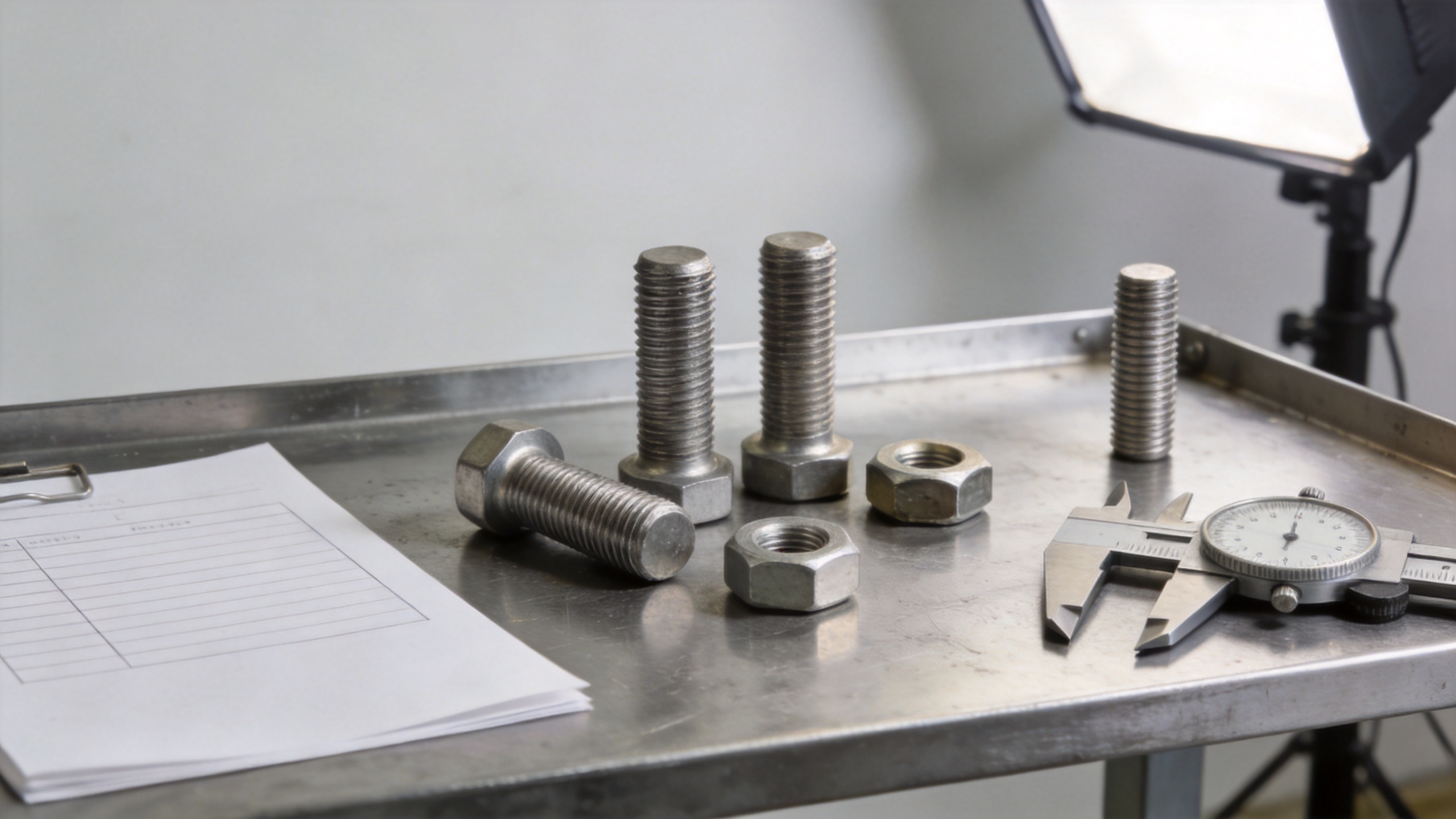
Use markings correctly
Head markings can be helpful, but they are not a standalone certificate. A marking can be absent because the applicable standard permits it for a size or product form; it can also be difficult to read after coating. Conversely, a visible mark does not establish that the underlying material and mechanical properties meet the order. Compare the mark only against the applicable specification and the supplier’s approved documentation.
For a stainless fastener, confirm the specified stainless designation and any required documentation rather than relying on color or a magnet test. For a threaded fastener, confirm the thread callout with the correct gauge or measurement method. For a mechanical fastener in a load-bearing joint, verify that the declared property class, size, and companion components align with the assembly requirement.
Make traceability usable at the receiving dock
Traceability should let your team answer three questions without reconstructing the shipment from memory: What was received? Which documents support it? Where did the released stock go? A practical record links receiving date, purchase order, supplier, part number, lot or heat identifier, quantity, inspector decision, document file references, and the storage location or work order released to.
Qingdao Jeekuu Hardware Products Co., Ltd. describes batch-based production information and pre-shipment specification sampling as part of its quality process. When sourcing from any supplier, buyers can request that the packing label and supplied documents use a consistent lot reference. This makes a later review more manageable, particularly when one delivery is split across bins or jobs.
Escalate with evidence, not assumptions
A hold decision should be factual. Photograph the outer label, inner label, part markings, and any visible condition issue; retain a controlled sample; record the quantity and storage location; and list the exact document mismatch. Ask the supplier for clarification, corrected documents, traceability evidence, or an agreed verification route. If the contract requires independent testing, use a qualified laboratory and test the correct representative sample under the applicable method.
Keep language neutral. “Lot on hold because the carton lot code differs from the certificate” is more useful than declaring intent. It protects the investigation, gives the supplier a clear response target, and avoids releasing an uncertain fastener into a joint.
A receiving checklist your team can use
| Check | What to compare | Action if inconsistent |
|---|---|---|
| Identity | Part number, size, thread, grade, finish | Hold the lot and compare with the order or drawing. |
| Documentation | Certificate, lot or heat reference, quantity, supplier identity | Request reconciliation before release. |
| Packaging | Carton and inner labels, seal condition, lot segregation | Photograph and isolate affected containers. |
| Physical sample | Markings, head style, thread condition, visible finish | Escalate for qualified review or specified testing. |
| Record | Receiving decision, evidence, storage destination | Maintain the link through release or disposition. |
Turn a one-time inspection into a supplier control
The strongest receiving process is repeatable. Review holds by supplier, part family, and discrepancy type. If a recurring issue appears, update the purchase-order notes, request clearer labeling, define a first-article or pre-shipment photo requirement, or increase the receiving sample plan for that risk level. A fastener that is easy to identify, document, and trace is easier to control before it reaches the joint.
For new or changed sources, ask for an inspection plan, a sample path, and the document set before the first production delivery. For established sources, keep the same discipline when the grade, finish, production location, or packaging configuration changes. That practical routine helps the team make a release decision based on evidence rather than appearance alone.
Assign the checks by fastener risk
Not every fastener needs the same receiving depth. Set the plan before the shipment arrives. A standard fastener used in a noncritical enclosure may need identity, count, and packaging checks. A threaded fastener used in a structural or pressure-related joint may need documented lot review, dimensional verification, and a defined escalation path. A mechanical fastener supplied for a safety-related assembly should be controlled against the applicable drawing and contract requirements. A stainless fastener for a corrosive location should be checked against its specified grade and finish documentation, not selected by appearance.
For each custom fastener, retain the controlled drawing revision with the receiving record. Compare the custom fastener sample to the approved dimensions and thread callout rather than to a visually similar catalog item. This prevents a fastener substitution from being hidden by a familiar head style or surface finish.
Record the result at lot level
- Record the fastener part number, batch identifier, quantity, and release decision.
- Record whether each threaded fastener sample met the specified thread check.
- Record the document reference used to review each mechanical fastener lot.
- Record the declared grade and supporting paperwork for every stainless fastener lot where material is specified.
- Record the drawing revision and comparison result for every custom fastener delivery.
This risk-based record does not replace testing when testing is required. It gives purchasing, quality, and production a common way to contain a suspect fastener lot while the evidence is reviewed.