EN

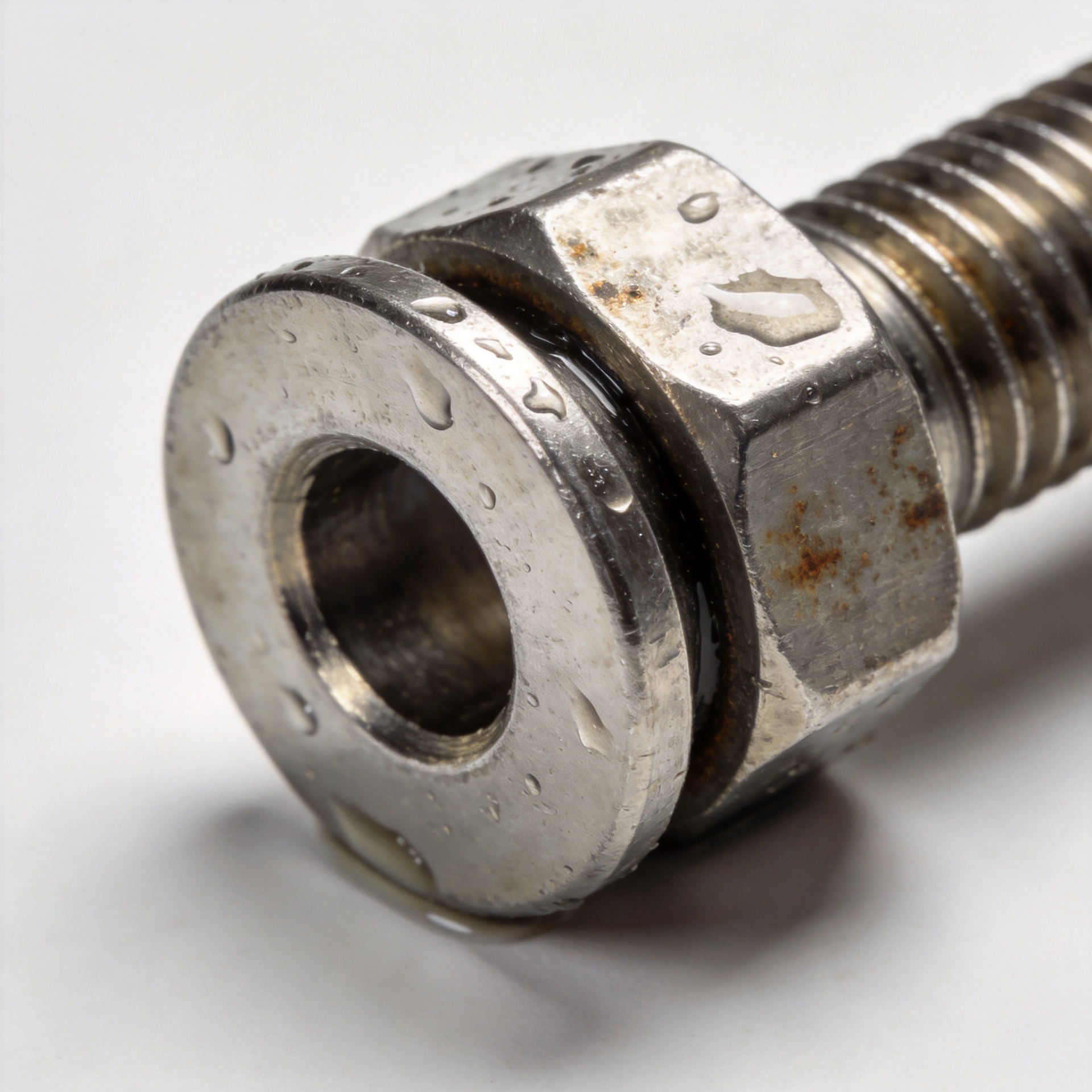
Why Galvanic Corrosion Appears Between Washer and Bolt in Wet Service
A washer can look like a minor part of a bolted joint, yet it often marks the first visible location of galvanic attack. In wet service, the washer, bolt, parent material, coating condition, and trapped liquid work as one electrochemical system. A fastening-selection engineer does not diagnose this by asking which individual part is “corrosion resistant.” The useful question is whether the assembled joint supplies dissimilar metals, electrical continuity, and an electrolyte at the same time.
That distinction matters because a dry joint may stay stable for years, while the same washer and bolt pairing can deteriorate after repeated wetting, condensation, salt exposure, or washdown. A flat washer may also create a narrow crevice that retains moisture longer than the exposed bolt head. The result can be white zinc corrosion products, red rust, under-film attack, staining, or localized loss around the contact line.
The three conditions that turn a washer joint into a galvanic cell
Galvanic corrosion needs three connected conditions: metals with different electrochemical behavior, an electrical path between them, and a shared conductive liquid. Remove any one of these conditions and the galvanic circuit is interrupted. This is why a material pairing cannot be judged from an alloy name alone.
- Dissimilar metals: A stainless bolt, plated steel washer, aluminum panel, copper-bearing alloy, or zinc coating may occupy different positions in a galvanic series.
- Electrical contact: Direct contact through the bolt, washer, or bare substrate lets electrons move. A thin passive film on stainless steel is not a dependable electrical isolator.
- An electrolyte: Rain, condensation, splash water, cleaning solution, salt residue, or polluted moisture can bridge the metal surfaces. Conductivity rises when dissolved salts or contaminants are present.
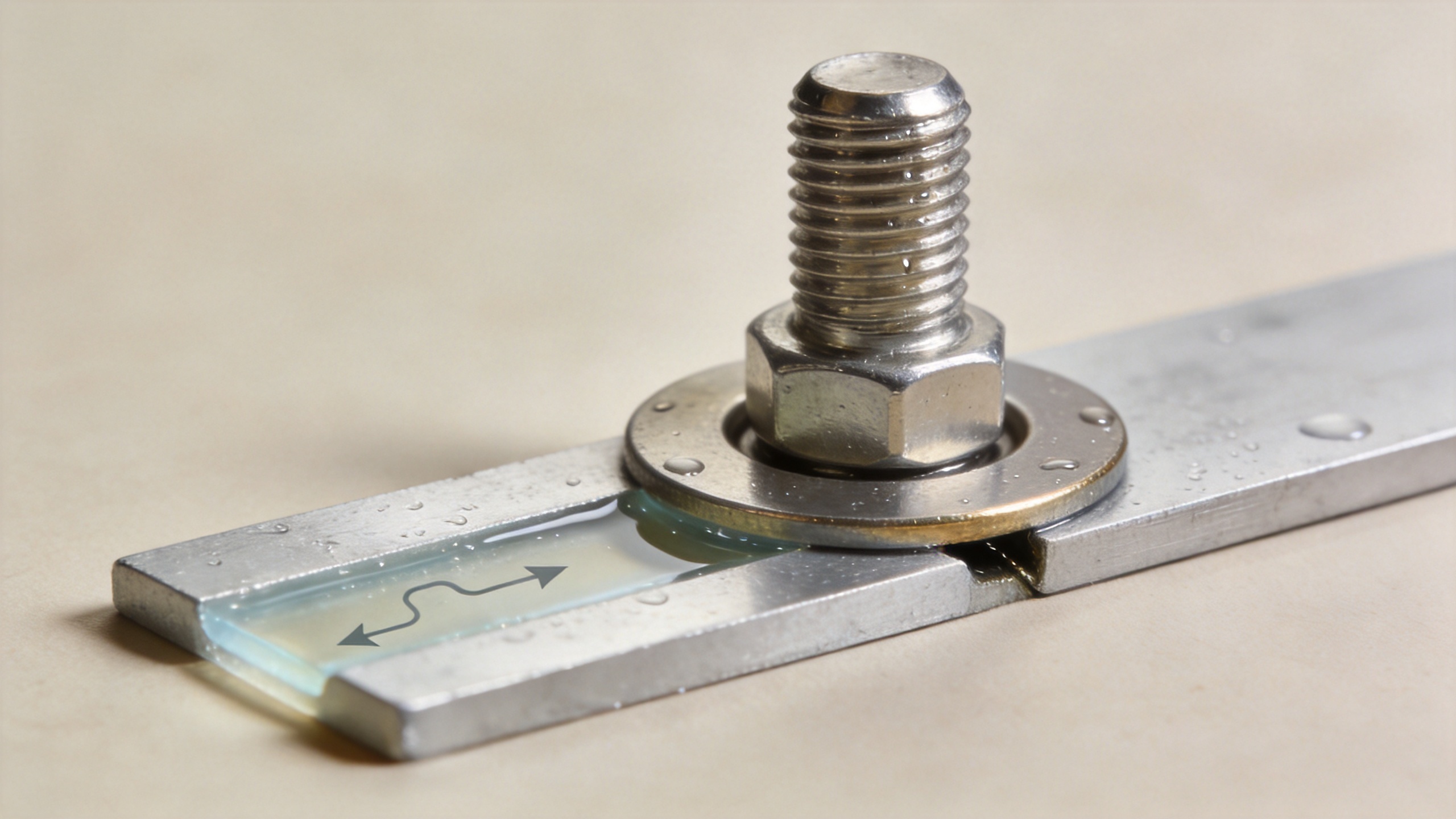
Wet service is therefore more important than it first appears. A washer contact zone can hold a thin liquid film after surrounding surfaces look dry. As that film evaporates, dissolved salts can become more concentrated. This concentrates the electrolyte exactly where clamping pressure and crevice geometry make inspection difficult.
Which part corrodes first?
In a galvanic couple, the more anodic member tends to corrode faster while the more cathodic member is comparatively protected. In a common field example, a stainless bolt in electrical contact with galvanized steel can accelerate consumption of the zinc coating when the joint remains wet. After local zinc is depleted, the exposed steel can begin to corrode. That does not mean every stainless bolt and galvanized washer combination will fail quickly; water chemistry, time of wetness, surface condition, and geometry decide the rate.
The same reasoning applies when a washer bridges a bolt and a base metal. A lock washer is not automatically safer because it maintains tension. Its spring form may create more edges and gaps where moisture persists, while its finish may differ from the bolt or substrate. Likewise, a spring washer can lose its protective finish at contact points during tightening. The contact scars are small, but they can be the electrically active locations once water enters the joint.
Why area ratio makes a small washer important
Engineers should look at the wetted area ratio, not only the fastener diameter. A small anodic washer coupled to a much larger cathodic surface may carry a relatively high corrosion demand at the washer. Conversely, a larger anodic area relative to the cathodic area is generally a more forgiving arrangement. Industry guidance commonly uses an anode-to-cathode wetted-area ratio of about 10:1 as an initial screening concept, not as a substitute for testing the actual assembly.
This is also why a flat washer can be misleading during visual inspection. The visible face may appear acceptable, but the underside can have a concentrated electrolyte and a poor area relationship with the clamped panel. Lift the washer during a failure review; looking only at the bolt head can miss the most useful evidence.
How wet-service conditions intensify the problem
Not all water behaves the same way. Clean, low-conductivity rainwater may support only limited galvanic current, whereas chloride-bearing splash, road salt, marine air, process water, and deposits in industrial areas create a more conductive path. Repeated wet-dry cycles are especially troublesome because they renew oxygen access and can concentrate residues in the washer crevice.
A sealing washer may reduce liquid entry when it is correctly specified, installed, and compatible with the joint. It should not be assumed to solve a galvanic mismatch on its own. If its elastomer or filler is conductive, damaged, compressed beyond its intended range, or paired with a scratched coating, the joint still needs a material and drainage review. For critical exposure, verify gasket composition, torque window, and chemical compatibility with the service fluid.
A practical diagnosis sequence
- Map the stack-up. Record the bolt, washer, nut, panel, coating, plating, insert, and any conductive gasket or sealant. Do not treat “stainless” or “zinc plated” as a full material specification.
- Inspect the hidden contact zone. Remove one representative washer and look for attack on the underside, coating loss, residue, crevice staining, and pitting around the hole.
- Identify the wetting route. Check whether rain, condensation, washdown, leaks, capillary gaps, or pooled water reaches the joint and whether drainage is available.
- Compare the pair in the relevant electrolyte. A galvanic series is environment-specific. Assessment in seawater does not automatically predict performance in low-conductivity indoor condensate.
- Check installation damage. Over-torque, burrs, serrations, tool slips, and washer rotation can break coatings and create bare contact points.
Selection and mitigation options
The most durable response is usually system-level, not a one-part substitution. Where feasible, select metals and finishes that are closer in galvanic behavior for the anticipated electrolyte. Keep compatible coating systems together and avoid making a small coated washer the sacrificial element beside a large, more noble wetted surface.
Electrical isolation is another option. Nonconductive sleeves, shoulder washers, or appropriately designed isolating layers can separate the bolt, washer, and substrate, provided the assembly still meets load, temperature, and creep requirements. Sealing and drainage are equally important: design the joint so water does not remain under the washer, and use a sealant only after confirming it does not introduce conductive fillers or trap water elsewhere.
Finally, specify the entire stack-up on the drawing and inspection plan. Calling out only a bolt grade leaves too much room for a mismatched flat washer, lock washer, or spring washer finish. In wet service, the washer is part of the corrosion-control design, not merely a load-spreading accessory.
Key takeaway
Galvanic corrosion between a washer and bolt appears when dissimilar conductive materials remain electrically connected and a wet electrolyte bridges them. The severity depends on material potential, electrolyte conductivity, time of wetness, coating damage, crevice geometry, and wetted area ratio. Evaluate the complete joint, inspect beneath the washer, and match the mitigation method to the actual service environment rather than relying on a single material label.