EN


How Do Custom Studs Support Complex Manufacturing Needs?
In industrial assemblies, studs are not simply headless bolts. They are engineered threaded components that create a controlled connection between parts, often where access is limited, alignment matters, or repeated service is expected. A custom stud gives a design team room to specify the thread, length, material, finish, and tolerances that the assembly actually needs instead of forcing a standard part into an unsuitable connection.
That distinction is useful in equipment frames, flanges, fixtures, pumps, enclosures, and other manufactured systems. A standard fastener may be adequate when geometry and service conditions are ordinary. Custom studs become valuable when the joint has conflicting constraints: a restricted installation space, different threads at each end, a sensitive mating material, corrosion exposure, or a controlled preload requirement. This article uses “studs” in the industrial fastener sense, not the jewelry meaning that can appear in broad consumer search results.
Why Complex Assemblies Call for Custom Studs
Complex manufacturing rarely fails because one dimension was omitted in isolation. Problems usually arise at the connection points: a tool cannot reach a nut, the engagement length is too short, a coating changes fit, or a replacement part does not match the released drawing. Custom studs allow the fastening arrangement to be designed as part of the assembly rather than treated as a late purchasing item.
For example, an assembly may need a long engagement on one side for a softer base material and a shorter thread on the exposed side for a flange and nut. It may need an unthreaded shoulder for location, a stop feature to protect a sealing face, or different metric and inch threads across the same component. These are practical reasons to develop a manufacturing stud around the joint function.
A useful engineering question is not “What is the most suitable option?” It is “What load path, access method, mating material, environment, and service process does this joint have?” That question keeps studs connected to their operating context.
Design Inputs That Make a Custom Stud Usable
A drawing or request for quotation should communicate more than nominal diameter and overall length. The following inputs make a custom design easier to review and manufacture:
- Thread definition: identify the thread system, pitch, class or fit requirement, handedness, and the thread length at each end.
- Functional geometry: define overall length, body diameter, reliefs, shoulders, chamfers, undercuts, and any locating surfaces.
- Joint conditions: state the target clamp load or torque method when available, plus vibration, cyclic loading, temperature, and access constraints.
- Mating materials: note the materials on both sides of the joint, especially when thread engagement or galvanic compatibility matters.
- Surface condition: specify the required finish or coating and clarify whether dimensions apply before or after finishing.
- Acceptance needs: identify critical dimensions, inspection method, lot traceability, marking, packaging, and documentation expectations.
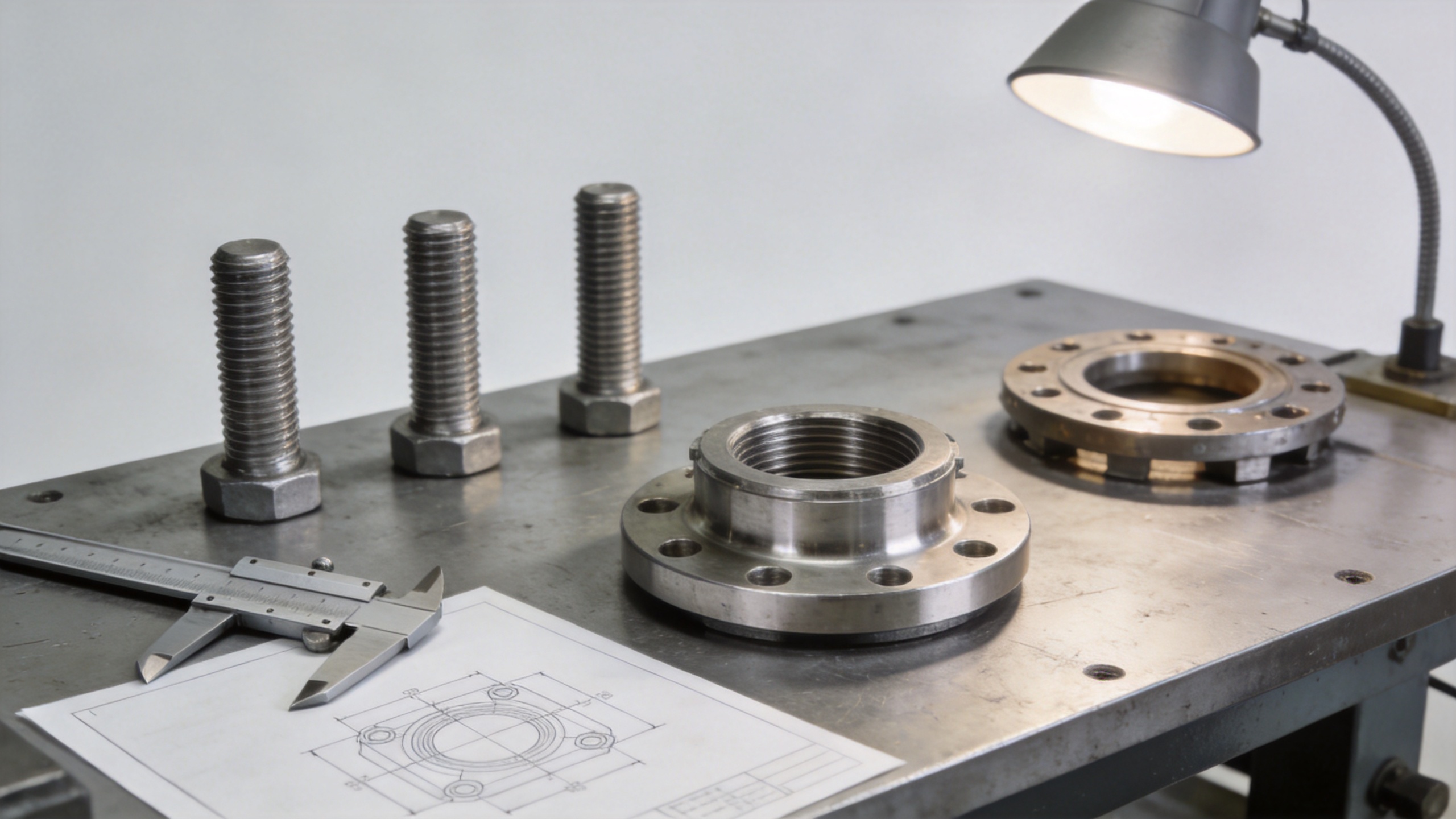
These details help avoid a common failure mode: a part that looks correct on paper but cannot assemble consistently. In particular, the relationship between thread tolerance, coating thickness, and the mating component should be considered together. Fine and coarse threads bring different assembly and tolerance trade-offs; neither is automatically the right choice for all studs.
Material and Finish Are Part of the Joint Design
Material selection for studs should follow the service environment, required mechanical behavior, and compatibility with surrounding components. Carbon or alloy steel may suit controlled indoor equipment; stainless grades may be considered where moisture or process exposure is relevant; other alloys can be evaluated when heat, corrosion, or special weight requirements drive the design. The appropriate choice depends on the complete application and applicable specification.
The finish deserves the same review. A coating can support corrosion resistance, appearance, or handling, but it can also influence thread fit and installation behavior. If a stud joins dissimilar materials in a wet or chemically active environment, the design review should also consider galvanic effects. For an OEM stud, documenting these decisions is often as important as naming a material, because the record lets future production batches be compared against the approved configuration.
How Custom Studs Improve Assembly and Serviceability
Well-defined studs can simplify production when a joint must be aligned before a heavy, awkward, or delicate component is installed. The fixed end can establish position while the external end receives the component and nut. This approach can improve repeatability in flanged assemblies and reduce handling time where a through-bolt would be difficult to insert.
Custom geometry can also protect the assembly. A controlled unthreaded section can locate a part without placing threads in a shear-sensitive area. A designed runout or relief can keep full thread from interfering with a shoulder. A specified end form can make initial engagement easier for operators without changing the functional thread. These choices make studs purposeful connection components rather than generic hardware.
Service considerations matter too. If maintenance requires repeated removal, the team can define the installed end, removal method, and replaceable side before release. A purpose-built stud may therefore reduce disturbance to a base component even when the visible fastener is routinely replaced.
From Prototype to Repeatable Manufacturing
Custom studs work most effectively when validation follows the same discipline as design. Begin with a released drawing or a controlled sample, then inspect the dimensions and threads that affect fit. A functional build is useful because it reveals tool clearance, seating, assembly sequence, and mating-part issues that a bench measurement may miss.
Before moving to production, align the sampling plan with the application. The team may review material evidence, finish requirements, thread gauging, critical dimensions, packaging protection, and lot identification. For a manufacturing stud used across several assemblies, a stable revision-control process is especially helpful: it reduces the chance that an informal substitution becomes an untracked change.
Supplier communication is part of this stage. Qingdao Jeekuu Hardware Products Co., Ltd. states that it supports non-standard processing based on customer drawings or operating requirements, alongside material options and pre-shipment specification inspection. Buyers should still provide the conditions and acceptance criteria needed for their own application; a supplier can manufacture to a clear requirement, but cannot safely infer missing design intent.
A Practical Sourcing Checklist for Studs
When sourcing studs, send the drawing, quantity range, target application, thread details, material and finish preference, critical tolerances, inspection needs, and packaging expectations. If the part is an OEM stud, include revision status and any approval sample requirement. Ask how the supplier will confirm thread fit, how changes are controlled, and what records can accompany a production lot.
The goal is not to over-specify every surface. It is to identify the features that govern assembly, reliability, and replacement. With that information, custom studs can support complex manufacturing needs by matching the fastener to the system, improving build consistency, and creating a clearer path from prototype approval to repeat production.